
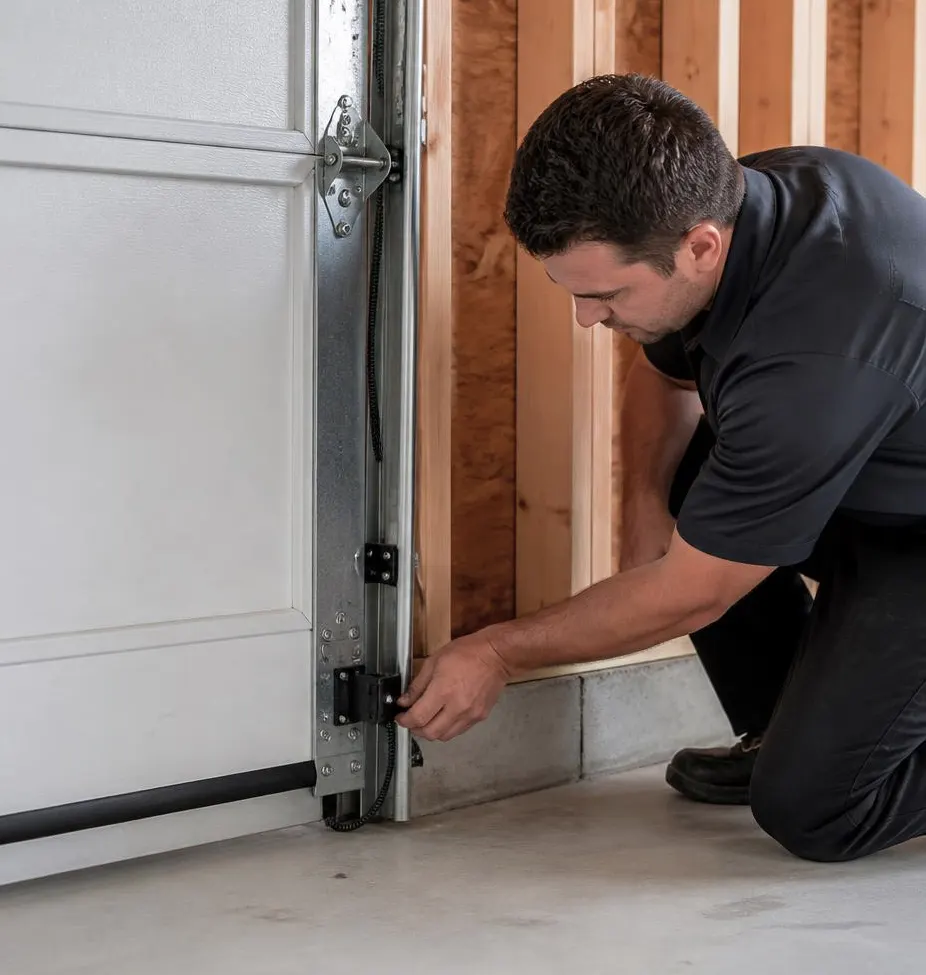
If your garage door won't budge on a cold morning, the most likely culprit is ice bonding the bottom seal to the slab, not a broken spring or burned-out opener. The exception is a door that was already acting up before the cold snap arrived — groaning on the way up, hesitating halfway, or needing a shove to get moving. Cold doesn't usually create new problems; it exposes ones that were already brewing in the weatherstripping, the lubrication, or the spring tension. Knowing the difference saves you from forcing a door that genuinely needs a technician, and from calling for service on a problem a hair dryer can fix in five minutes.
The Symptoms That Point to a Cold-Weather Problem
- Visible ice or frost along the bottom seal where the door meets the concrete, sometimes with a thin sheet connecting the two.
- The opener runs but the door doesn't move, or it lifts an inch and the motor strains against resistance.
- The door reverses itself partway through closing, as if something is blocking it, even though the path is clear.
- A grinding or groaning noise from the springs or rollers that wasn't there in warmer weather.
- The door moves, but slowly, like it's fighting through molasses on the way up or down.
- Panels or the bottom section look damp or have frozen drip lines from melted snow that refroze overnight.
What to Check, in the Order a Technician Would Check It
1. Ice Bonding the Bottom Seal
This is the first and most common issue, especially after a day of melting snow followed by an overnight freeze — a pattern this area sees often with the freeze-thaw swings between storms. The rubber astragal at the bottom of the door sits in a puddle, the puddle freezes, and the seal is now glued to the concrete. Never force the opener against this; you'll strip the gears, bend the top section, or snap a cable. Instead, use a hair dryer or heat gun on low along the seal line, pour warm (not boiling) water along the threshold and towel it dry immediately, or use a calcium-chloride de-icer made for door seals. Avoid chipping at it with a shovel or ice scraper — that tears the rubber and makes the next freeze worse.
2. Worn or Flattened Weatherstripping
If this is happening repeatedly, the seal itself may be the real issue. Older doors — and there are plenty of original units still in service on houses throughout the Mon Valley — often have bottom seals that have gone flat, cracked, or pulled away from the track. A seal in good shape sheds water instead of trapping it against the slab. A flattened one holds a puddle right where it refreezes. The fix is a full astragal replacement, which is inexpensive and takes a technician only a few minutes, but it has to be the correct profile for your door's bottom section to actually seal.
3. Thickened or Dried-Out Lubrication
Cold stiffens grease. If the rollers, hinges, and torsion spring haven't been lubricated with something rated for winter temperatures, the whole system moves slower and puts more strain on the opener. Old, gummed-up lubricant combined with road salt tracked in on car tires creates a gritty paste that binds in the tracks. The fix is cleaning the old residue off rollers and hinges with a rag, then applying a silicone or lithium-based garage door lubricant — not WD-40, which is a solvent and actually strips lubrication rather than adding it.
4. Spring Tension Lost to Cold
Metal contracts slightly in the cold, and torsion springs that are already older or corroded from years of salt-laden winter air can lose enough tension that the door suddenly feels noticeably heavier. This shows up as an opener that strains, clicks, or stalls partway through a cycle. A technician checks tension by hand with the door disconnected from the opener; if the door won't hold itself halfway open, the springs need adjustment or, if they're pitted and aging, replacement. This isn't a DIY step — torsion springs are under enough tension to cause serious injury.
5. Opener Force and Limit Settings
A stiffer, colder door needs more force to move than the opener is currently set to provide, which is exactly when you'll see auto-reversal or a motor that runs without turning the drive gear. A technician recalibrates the force and travel-limit settings rather than just cranking the force up, since set too high, the opener stops protecting against obstructions — a real concern with kids or pets in the garage.
6. Track Alignment and Roller Condition
Repeated freeze-thaw cycles can nudge brackets and tracks slightly out of alignment over a season, and steel rollers exposed to road salt and moisture start to pit and bind. If the door moves unevenly, drags on one side, or makes a distinct rubbing sound only on one track, this is usually the cause. The fix is realigning the tracks and swapping worn steel rollers for sealed nylon ones, which hold up far better through a Pennsylvania winter.
7. Drainage at the Threshold
If the ice-bonding problem keeps coming back no matter what you do to the seal, check the slope of the concrete apron in front of the door. A slight dip or settled section lets meltwater pool right at the threshold instead of running off, guaranteeing a fresh ice bond after every storm. This is a longer-term fix — regrading, patching the low spot, or adding a threshold seal kit — but it's worth addressing if you're dealing with a frozen door more than once or twice a season.
When to Call New Eagle Garage Door
If you've thawed the seal and the door still won't move smoothly, if the opener is straining or reversing, or if you hear a loud bang followed by a door that won't budge at all, stop trying to force it. That combination usually points to a spring problem, and our Spring Replacement service handles it safely with the right tools and tension gauges. If it's the middle of a nor'easter and your door is stuck wide open or won't close at all, our Emergency Garage Door Service covers New Eagle, Monongahela, Finleyville, Donora, Charleroi, Belle Vernon, Rostraver Township, and Carroll Township, so you're not left exposed overnight. A pre-winter tune-up — checking seals, lubrication, and opener settings before the first hard freeze — catches most of this before it becomes an emergency call.
If your garage door is fighting you this winter, call New Eagle Garage Door. We're the garage door company New Eagle, PA homeowners trust for honest diagnoses, fair pricing, and showing up when we say we will.