
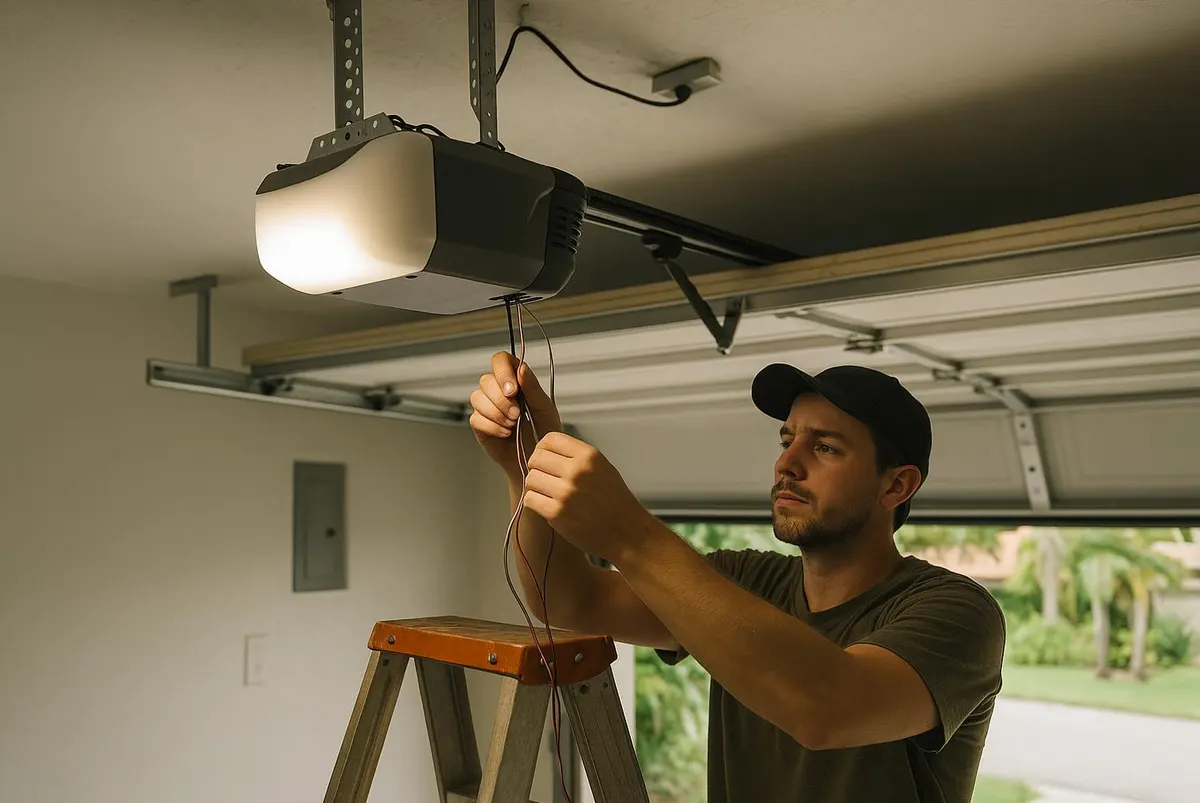
When a garage door starts groaning, hesitating, or reversing for no reason, most homeowners reach for the opener first. They pull up the ladder, find the force adjustment screw on the motor unit, and turn it up a notch so the door "tries harder." It's tempting because the opener is the part making noise, it's the only component with an obvious adjustment dial, and the fix takes about ninety seconds. The problem is that the opener is almost never the root cause. If the door itself is unbalanced, cranking up the force just hides the real issue while putting more strain on gears, belts, and circuit boards that were never designed to compensate for bad spring tension.
What an Unbalanced Door Actually Does to Your Opener
Garage doors are supposed to be counterbalanced by their springs so that a person could lift the door by hand with one arm. The opener's motor isn't built to lift serious weight — it's built to guide a door that's already balanced. When springs lose tension, a cable stretches, or a track shifts out of alignment, the opener suddenly has to supply the muscle the springs used to provide. That shows up as a motor that strains on the way up, a door that slams down faster than it should, gears that wear out early, belts or chains that stretch or snap, and safety sensors that misread resistance and refuse to close properly. Over time, an opener fighting an unbalanced door can overheat, trip its own protection circuit, or fail months earlier than it should have.
Tools You Need
- Work gloves
- A flashlight
- A sturdy step stool if your release cord is high up
- Optional: a locking pliers or clamp to secure the track as a safety backup
No electrical testing, multimeters, or spring tools are needed for this part — that's exactly the point. This is a visual and manual test anyone can run safely.
How to Test Garage Door Balance
- Close the door completely. Start from a fully closed position so you have a consistent baseline.
- Disengage the opener. Pull the red release cord hanging from the trolley to disconnect the door from the opener arm. The door should now move freely by hand.
- Lift the door to about waist height. Use both hands, lift smoothly, and let go.
- Watch what happens. A balanced door will stay roughly in place, drifting no more than a few inches. A door that slams shut or shoots upward on its own is out of balance.
- Repeat at two more heights. Test again around the quarter-open and three-quarter-open positions. Some doors are balanced in the middle but not at the extremes, which points to a specific spring or cable problem.
- Feel for uneven weight. If one side feels noticeably heavier than the other as you lift, that usually means one spring or cable is doing more work than its partner.
- Reconnect the opener and run it through a full cycle. Listen for grinding, hesitation, or a motor that sounds like it's laboring at a particular point in the travel — that's the opener compensating for the imbalance you just found.
What a Homeowner Can Handle vs. What Needs a Technician
Running this test, listening for strain, and noting where the door drifts is completely safe for a homeowner to do. What comes next usually isn't. Torsion springs store enormous tension, and adjusting, repairing, or replacing them requires specific bars and techniques that have seriously injured people who tried to wing it with a wrench and a ladder. The same goes for recalibrating opener force and travel limits correctly once a spring issue is present — doing that without fixing the balance first just resets the clock on the same problem. If your test showed drifting, slamming, or uneven lifting, that's the line where it's time to call in a technician rather than keep adjusting things yourself.
Why This Matters More Heading Into a Mon Valley Winter
Cold snaps, freeze-thaw cycles, and road salt tracked in on tires all take a toll on garage door hardware in this part of Pennsylvania. Spring steel loses a small amount of tension as temperatures drop, which can turn a marginally balanced door into a clearly unbalanced one right as the first hard freeze hits. Ice buildup on tracks adds extra resistance the opener has to push through, and a lot of the original housing stock around here still has decades-old springs and cables that were never sized for today's heavier insulated doors. Catching a balance problem now, before the first nor'easter or icy week rolls in, means dealing with it on your schedule instead of at 6 a.m. with a frozen door stuck halfway open.
When to Call New Eagle Garage Door
If your door drifted, slammed, or felt lopsided during the test, call New Eagle Garage Door before the opener takes more damage trying to compensate. A technician will check spring tension, cables, and track alignment, and handle spring replacement safely with the right tools if that's the issue. If everything's close but not quite right, our garage door maintenance service covers balance adjustment, lubrication, and hardware inspection so the door and opener are both ready for winter instead of fighting each other every time you pull in.
Serving New Eagle, Monongahela, Finleyville, Donora, Charleroi, Belle Vernon, Rostraver Township, and Carroll Township — call New Eagle Garage Door today to get your door balanced and winter-ready.